Saturday, May 11, 2013

A Shared River


In our short time here, we have seen the Rio Grande from many angles as it flows gently along (very gently during this drought) creating a natural border between the United States and Mexico. Despite the international border, most folks in the Big Bend area consider those across the river to be neighbors. The divisions, after all, are man-made, and the inhabitants of both sides share the same climate, the same topography, and many of the same challenges.

When fires burn here in the park, many of those employed to fight the fires come from the small Mexican town just across the park border - and prior to 9/11 the small town of Boquillas, Mexico just across the river relied heavily on tourism dollars from park guests who crossed over from the park for a few hours or a day to visit the remote village, purchase hand made trinkets and enjoy tacos or burritos at the two small restaurants. In addition to the tourist dollars spent on modest meals and hand crafted trinkets, many villagers made a modest living providing transportation to visitors to get across the river and then from the river to the town by either burro or truck bed.


Since 9/11, the border crossing in the park has been closed. Without the tourist dollars, the families of Boquillas, the remote Mexican village with no electricity and limited access to modern communications have struggled to find alternative livelihoods.  Fortunately, the border crossing has once again re-opened.

Just over 3 weeks ago, the crossing, which includes a small new re-entry building on the U.S. side that utilizes a Kiosk and remote conversations with border agents in El Paso, opened to park visitors five days a week and visitors are once again making the short trip across the river to spend the day in the neighboring town of  Boquillas. The photo above was taken from the U.S. side of the crossing. Across the river you can see that industrious Mexican men are waiting with trucks and burros to take tourists up to the town. As Andre & I do have our passports with us, we plan to make the trip over to the village in the next week or two, perhaps with some other volunteers from the park. We will report back on the adventure!


A

Friday, May 10, 2013

Oh the Creatures You Will See....

Before we started our Volunteer engagement here at Big Bend, we had been sent a packet of brochures, books and information to help us learn about the park before we arrived.  Over the months prior to our arrival, I devoured the information, anxious to know what was in store for us in West Texas and Big Bend Country. It was overwhelming and also exciting to think about all that we would encounter.

After spending 12 days here, I now know that brochures and booklets only tell half the story. To really feel the heart of Big Bend, you need to experience it first hand. Feel and smell the dry desert air. Get pricked by a cactus. Be startled by a Javalina (Collared Peccary, looks a bit like a furry pig), a long-eared Black-tailed Jack Rabbit, or hopping cotton-tail during an early morning walk.

You need to accustom yourself to the taste of dust in your mouth (and every other pore, crevice and pocket), and wearing a hat like a second skin to protect you from the hot desert sun. You marvel at the speed of a snake as it races across the road (if it's pinkish-red it's likely a Western Coach whip), and keep your eyes pealed to the road ahead for those fast moving Great Roadrunners or the slower moving Tarantulas that you want to avoid running over.

Of course there are all types and sizes of our lizard friends, and we see them often on rocks, roads and trails. Sometimes they are easiest to find if you look in the mouth of a Roadrunner! Twice over the past few days we have come across a Roadrunner on a trail, enjoying a nice "lizard lunch". At all times be on the lookout for the elusive Mountain Lion (haven't seen one yet but we are told that they have probably seen us!).

And if you are really lucky, like we were just a few evenings ago - you will get to watch in awe as a momma bear and her cubs take their time sauntering across the road as they take their early evening stroll. There are still countless animals we have yet to see - both mammals & reptiles alike - but we've made pretty good progress thus far.  One thing we need to improve on, though, is being quicker with the camera when encountering wild life! I'm often so excited to see the animal, that by the time we get the cell phone out, it's long gone (or skittering away down the trail laughing at us slow humans).  We did manage to get a good shot of the bears, though. And a few other easier shots. 


Adult female and three cubs sighted 3 days ago


Wolf Spider Crawling on a rack in the visitor center (NOT poisonous)
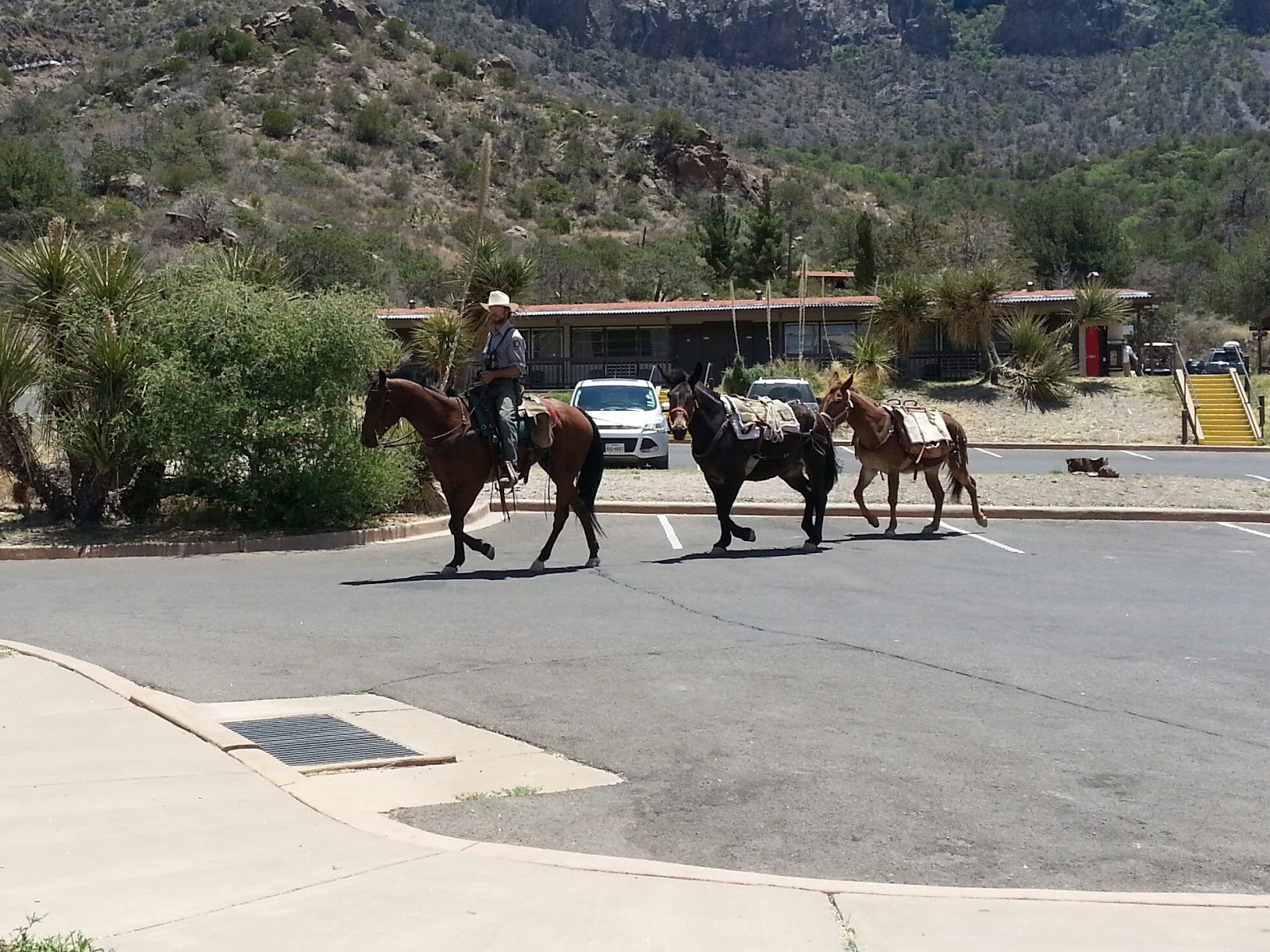
Ranger leading pack burros to a trail (this one was easy to get!)

Thursday, May 9, 2013

A Day in the Life (Andre)

This entry is an homage to the adage that a frog that jumps into a pot of boiling water will jump right out, whereas a frog in a pot of cool water will hang out and die while the temperature is slowly increased. I have always taken this tale to mean, among other things, that it is important to fully explain oneself because what might be so clear to one person can appear to be very different to another!
What follows is the typical routine for us as volunteers in a visitor center at Big Bend National Park. (We work three days a week in the visitor center – the other day is a project day in the park and we will describe that later.)
Part 1: We leave our apartment about 7:50 and walk to headquarters – about 10 minutes away, to check for messages, supplies, and to get a park vehicle to drive the 10 miles up the mountain to the visitor’s center.
Part 2: We open the visitor center. This includes turning on the lights and video program, raising the flag, changing the dates on the passport stamp, opening 2 cash registers – one for admission fees and one for bookstore items, calling in the weather readings, posting the daily weather, and making sure everything is in place for the day.
Part 3: We unlock the doors by 8:30, close for lunch from 12- 1, and then close for the day at 4:00. During the hours we are open, we do all of the following: answer questions about the park, provide recommendations for good hikes and camping spots, issue back country camping permits, record wildlife sightings, sell items in the bookstore, and be a general positive presence for the park. We average about 100 or so visitors a day. When it is slow in the visitor center, one or both of us also walks around the grounds and short trails around the visitor center. We also will occasionally walk and drive to near-by trail heads and make sure there are maps, re-supply as needed, and look out for trash.
Part 4: We close the visitor center. This includes taking down the flag, turning off the lights and video machine, closing out the registers, and locking the doors and windows.
Part 5: We return to headquarters where we return the park vehicle, place the daily receipts in a safe, and turn in all the permits that were written during the day. We then walk back to our apartment smiling for the good work and things we had done that day!

Behind the Desk at the Visitor Center


Wall Map Highlights Recent Bear/Mountain Lion Sightings

Popular Mountain Lion Exhibit

Chisos Basin Visitor Center

Temperature and Big Bend National Park (Andre)

I used to be middle school social studies teacher and one of the topics I would enjoy sharing with students is how as you increased your elevation, i.e. climbed a mountain, the temperature got cooler. (The sun heats the Earth, heated air radiates from the ground, mountains being further from the ground, the air would be cooler, or so the discussion would go.)
As backpackers who spent a decent amount of time in the mountains of New England, we knew this truth and had experienced it many, many times.
In west Texas, where Big Bend National Park is located, temperatures work the same, of course, it is just the perspective that gets turned around a bit. People here, the best we can tell, look at temperatures from how low, in elevation, you go.
For example, we are staying at Panther Junction which is 3750 feet. We work at the Chisos Basin Visitor Center which is at 5400 feet. The Rio Grande and Rio Grande Village is at 1850 feet – the lowest elevation in the park. (We have not climbed the highest peak yet, Emory Peak, but that is 7832 feet.) Our second day in the park, the warmest it has been so far, Panther Junction got to a high of about 90 degrees. Chisos Basin a high of about 83 degrees. The Rio Grande – 108 degrees.
How this play out here, is that people assume no one wants to go ‘down’ to the river – it is too hot! Similarly, there are three visitor centers at the low elevations – they all close for the season (meaning summer, by the first of May and do not re-open until November!)
We appreciate and understand the perspective – but being out-of towners, we went down to the River today – it was only 98!

Hot Springs (left, 105 degrees) and the Rio Grande (behind)

Tuesday, May 7, 2013

I’m Not Kidding – Central Air! (Andre)

Okay, so you might be expecting tales of great peaks, stupendous wildlife, exotic flora and fauna – well there is that and lots more. And, I hope we have started to and will continue to communicate these things to you, for example, we saw a western coachwhip today, better known as a red racer snake today, think 6 or so feet, redish, and moving really fast on the ground!
Western Coachwhip

But, you signed up for the unedited version. So, here goes ……..
We were out today, first day we drove into the big town, Alpine, Texas – look it up, a few thousand people. It has a McDonalds, a supermarket, post office, gas stations, radio shack, etc, and only a short 110 miles from Big Bend, or in west Texas lingo, right around the corner!
We got back to the apartment with a van full of groceries around 10:00 PM to put away. Did I mention the 2 growlers of free beer from Big Bend Brewing Company in Alpine – that will be another story.
But, it was warm, like 80 at night. It was then we realized that we had central air – first time ever in our lives.
We pressed a button, and we are not hot anymore – what else are they hiding in Texas we wonder!


Saturday, May 4, 2013

We Got an Apartment! (Andre)

Yes, you read that right – we have an apartment. It is apartment 215B on Chino Drive in the Bobcat Loop at Big Bend National Park, Brewster County, Texas. The last time Laura and I moved into an apartment was in 1985 when we moved into a great apartment in an old barn in Rehoboth, MA. We think it might have been the only apartment building at the time in that small, rural, New England town. Our first child, Dylan, was born there. We were 22! We had a cat named Zeus, soon to be followed by our second cat, Hera. (Sorry Nick, you were not born yet!) That was a long time ago. (And in great coincidence, as I write this, I am listening to the Deer Tick song – a great Providence band, Smith Hill, which is where our apartment immediately prior to Rehoboth was!!)
So, you ask, how did this come about?
Well, let me tell you –though, it may take a while.
As we have travelled towards Big Bend and our first volunteer position, we earnestly spoke to everyone we met who had volunteer experience to pick their brains and learn what we could. One important common theme we heard was that volunteer experiences vary greatly, that you should learn as you go, and as volunteers, you are providing a valuable service, AND, if the experience is not great, speak up!!!
So, we arrived at Big Bend on Sunday afternoon. It was an amazing journey here. It is like being at the end of the Earth! The access road to the park is 67 miles. There is nothing but desert along those 67 miles. Don’t think there was a lot before those 67 miles either – there was a small town (1 block) and then 40+ miles more to the next small town. Basically, it is a 100+ mile drive to get to the park.
We were a few days early for our assignment. We were placed at a temporary site about half way up the mountains – about 3700 feet, at Panther Junction. It was a nice location with great mountain backdrops and we had limited cell service and a bit of internet via our mobile hotspot. The next day, we were given a tour of the park and our intended campsite at Chisos Basin.


Basically, Chisos Basin is a 30 million year old volcano. And the visitor center and our campsite was in the cone of the ancient volcano. All very cool and the site was amazing. Think about being surrounded by jagged teeth left over by the rim of the tall, sharp, peaks left behind.
But, then there are the details. The visitor center, where we are working, is at 5400 feet. Our campsite is at 4600 feet, about a mile walk or bike ride up or down, depending on the time of day, a rather step incline/decline. (Don’t start thinking wimps – you try it twice a day in desert climate!) Most people who take this volunteer position come with a tow car on their RV for such circumstances, to drive back and forth – we carry bicycles! Other factors included the following: there was no cell or internet service at Chisos Basin; staying at Chisos Basin put us farther away from most of the other places in the park we wanted to visit; Panther Junction, where we stayed at a campsite the first night, is where the post office is; and, if we wanted to use national park vehicles, they were garaged at Panther Junction. Small kicker, we saw another volunteer with their own national park vehicle.
What is the Bob Dylan line, ‘I did what any hobo sailor did – I jumped into line hoping that I was not late??’
We asked if we could move back down to the Panther Junction campsite we were in our first night. We would have some cell/internet service – god willing, we would be closer to other parts of the park we would like to visit, we would save wear and tear on the van – major factor, and then there is access to the national park vehicle issue.
Well, the gods did us one up. Because as I write this, as was indicated above, we are indeed in Panther Junction. But we are not in a campsite. We are not living in a van! We are now in an apartment for the first time in nearly 30 years! (Laura says I should add that it is free – complimentary!) Yes, 4 walls. One bedroom. Large living room. A bathroom! Kitchen, AC, – you get the picture. The apartment is in good shape – clean, fairly modern, in good repair, did I say clean – very important to us.


We got the keys to the apartment at 5:30 PM on Thursday. We worked diligently until about 9:00 PM and had moved in fully. Did I say it was a furnished apartment and in real good shape? 
Which brings me back to an important point and I am sorry a common theme in these few short weeks we have been on the road – the unknown road ahead.
Prior to 3 weeks or so, we had never been in Texas. We have never cast our lot into the wind. We haven’t had an apartment in 30 years. We haven’t seen the many things or experienced the many things we have been so fortunate to be part of, and now we have an apartment!!!!!!!
Life is not so bad!

Just a few of the beautiful Scenes in the Park

Wednesday, May 1, 2013

First Day in the Chisos Basin Visitor Center

Another quick post with a photos. Need to hurry along so we can ride back to our site before dark. Today was our first day training for our Visitor Center Duties. It went well but was exhausting as we spent the full 8 hours talking and learning and talking some more to folks from all over the world. Often we didn't know the answers to their detail questions, but did our best to find out or in some cases, make an educated guess.

 Some parts were quite easy for us, given our backgrounds. We've both worked in retail, worked with cash registers, computers, maps etc. Most of our time was spent helping hikers plan their hiking expeditions and make camping arrangements at the various camp grounds, back country sites and open spaces.  Here are a few quick photos from day 1.

Our Visitor Center (featuring mountain lions)